For the last 8 years, we've spent our time in software development making programs, apps, and websites for ourselves and our clients, all aimed at solving actual problems. We've dabbled in open source, done a lot of consultancy, and spent quite a lot of brainpower improving the lives of people we closely know ( such as restaurant managers and their customers ).
This will always be our primary mission. Solving people's real-life problems is our north star, and what drives us to always be better.
That being said, we're making a game.
Why
Games as a VLK interest
The most important part of this is that games are a genuine passion for many people at VLK, and we don't mean that lightly.
Collectively, we've spent tens of thousands of hours playing games of all sorts. From our routine tabletop nights (at Aurora), to eSports titles (also at Aurora, see Aurora Versus), to all kinds of single-player games we spent our childhoods on and still play heavily to this day.
Despite not having any real in-house expertise in the field, we do believe our collective knowledge and sheer love for the craft could prove to be an important strength.
Games as a creative outlet
Most of the software we've built up to this point has been designed to solve problems or optimize someone's business. Games give us a medium to build software around curiosity, narrative, emotion, and what we genuinely feel is fun.
We can let go of thinking only in terms of "What's the most intuitive user experience?" or "What's the least amount of information we can show?" and instead ask things like: "What's more immersive?", "Is this challenge interesting?", or "This icon is a bit silly, but we'll keep it because why not?"
Games as technology
Gaming has been a growing market for decades, and many of its ideas have quietly made their way into software of all kinds. Even some of our most "boring" work has occasionally called for some form of gamification.
Despite the similarities, game development is also a vastly different area of expertise. It may require working with technologies and disciplines we seldom touch, such as sound, 3D, and animation, and we do love a challenge.
What can we make?
Like much of our work, the idea came from an actual desire, helped along by a technological hint: AI.
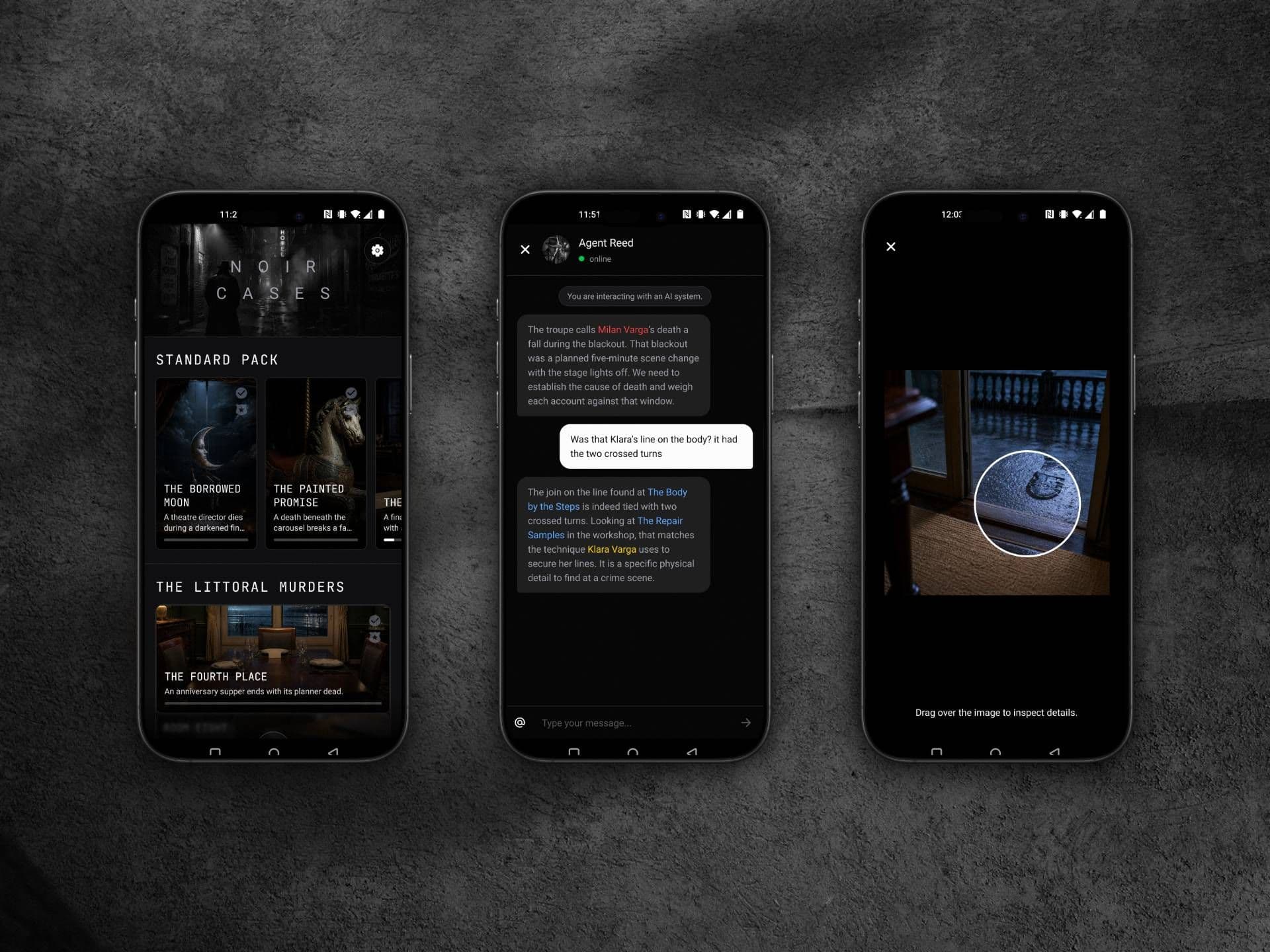
Most of us interact with AI every day. It's becoming a core part of how we develop software, and chatting with an LLM has become a regular part of our day-to-day lives. We stretched that habit into the idea of a proper crime-solving game, and just like that, Noir Cases was born.
Noir Cases is a mobile game where you solve crimes by chatting with an AI detective partner, Agent Reed. The agent acts as a natural gate for your deductions: by asking the right questions, you unlock secrets and hidden evidence, discover motives and relationships, and gradually uncover the whole story.
This type of software fits our skill set very well. We have a lot of experience working with AI, making mobile apps, building and controlling agents, and creating interfaces that feel great to use.
Instead of throwing us straight into completely unfamiliar territory, such as game engines, 3D asset pipelines, and so on, Noir Cases gently nudges us into the gaming field while still making heavy use of our core expertise and know-how.
An LLM as a gameplay feature
A big part of making this game has been spent working on the detective partner, and it's the aspect we believe makes Noir Cases worth existing.
From a gameplay perspective, it's an interesting paradigm. An LLM can massively increase immersion for the player in a way that a fully pre-programmed NPC probably couldn't. It allows players to explore a puzzle in a way that is unique to them, while the agent adapts and plays along.
Some players enjoy heavily role-playing, describing every action they take to the agent: "I'm going backstage to talk to this suspect." Others prefer more detached, puzzle-solving inquiries, such as: "I believe the coat was poisoned because..."
Naturally, this requires careful alignment of the agent, because in our experience players can and will try to break it.
We've spent a lot of time teaching the agent how to:
- Not go off-track
- Not spoil the case or help the player too much
- Not break character
This has proven to be a fitting challenge for us. It required careful analysis of things such as model choice, system prompts, case context, player discoveries, agent personality, and more.
The agent is still constantly improving. Sometimes it still helps players a little too much, but we believe it's now in a good sweet spot and makes for a great role-playing experience.
Where this could lead
At this point, Noir Cases is still an experiment. It's an idea we collectively believed could work and, most importantly, that could prove fun for players.
Maybe this becomes the first of many games. Maybe it changes how we think about building aligned AI agents. Or maybe it will simply remain an experiment.
In any case (pun intended), it has already done its job in pushing the boundaries of what we do at VLK.
We don't consider this, or any future games, a departure from our usual work, but another way of asking ourselves what software can be.
UPDATE 15-09-2026
Noir Cases is now live!
Get in App Store: https://apps.apple.com/us/app/noir-cases/id6759349066
And Play Store: https://play.google.com/store/apps/details?id=com.vlkstudio.noir&pli=1